Archiv rubriky: Přístupnost aplikací

UX Salzburg & WebExpo 2026: AI in Accessibility – Revolution or a Well-Marketed Trap?

I’ve been around the block long enough to know that in the world of accessibility, many people are looking for a „magic wand.“ For years, it was the dream of fully automated testing and the ultimate „Turn Accessibility On“ button—a single click that would magically fix everything. Today, that wand is carved from Artificial Intelligence.

Following a recent session with Lukáš and me at 35. UX Salzburg Evening and looking ahead to WebExpo 2026 in May, I find myself returning to a familiar skepticism. Is AI a revolution that will finally bridge the accessibility gap, or is it a dangerous trap that trades real usability for a false sense of legal security?

The Accessibility Paradox: Stuck at a „D“ Grade

Let’s look at the cold, hard numbers first, because data should always be the foundation of our story. Despite thirty years of web standards, the WebAIM Million analysis consistently shows that about 96 % of the top one million homepages still fail basic WCAG audits. Technology is advancing, but the fundamental structure of the web remains largely inaccessible. According to Fable’s AUS analysis, the average desktop experience for users with assistive technology scores a 56 out of 100. In academic terms, that’s a „D“ grade.

However, let’s not paint a purely dystopian picture. It would be a mistake to claim that the web is completely unusable for people with disabilities. On the contrary, many things have improved tremendously. My colleagues today routinely navigate even highly complex environments like Google Workspace, manage their own blogs on WordPress, YouTube channels and podcasts, or handle online banking. This progress isn’t thanks to some AI „magic button,“ but the result of systematic work on core platforms. We are scaling quantity faster than usability, but where there is genuine intent and „Accessibility by Design,“ the digital world is more open than ever before.

The „One-Line“ Illusion and the Trap of Easy Fixes

The biggest „Balrog“ we’re facing right now is the rise of Accessibility Overlays. For many, these tools represent the ultimate fulfillment of that „Turn Accessibility On“ button I mentioned earlier. Since the European Accessibility Act (EAA) enforcement became an active legal mandate in June 2025-and with the general global trend of increasing fines and sanctions—accessibility has shifted from a „nice-to-have“ to a source of corporate panic.

And here comes the trap: many companies, driven by the fear of litigation, are looking for shortcuts to avoid penalties. Instead of following the path of functional platforms that truly worked hard on their accessibility, they reach for a single line of JavaScript. But from my experience, this is a dangerous disservice for several reasons:

  • The Illusion of Compliance: Relying on an automated patch does not protect a business from legal liability if a user cannot complete a functional journey.
  • Technical Conflict: When AI attempts to „repair“ broken code on the fly, it often creates a secondary layer of data. Screen reader users end up receiving conflicting information—the original mess and the AI’s „guess“-leading to massive confusion.
  • The Keyboard Navigational Cage: These tools often inject their own toolbars that become „navigational traps“ for keyboard-only users, making the site less accessible than it was originally.
  • Profit Over People: Many providers have built their business on the fear of lawsuits, often hiding under a veil of „helping the handicapped“ while their solution brings zero real value to actual users.

As I often say, every pressure creates a counter-pressure. The pressure of legislation and the threat of sanctions have unfortunately awakened solutions that prioritize a „Compliance Certificate“ over the actual human experience.

7 reasons accessibility overlays SUCK (YouTube)

The Good, The Bad, and The Hallucinated

To navigate the future of accessibility, we must move from viewing AI as a „gimmick“ to viewing it as a tool that requires human supervision. AI doesn’t have a soul or intent; it has patterns. And while patterns can be helpful, they can also lead to „hallucinations“ that create new barriers for users.

The Failures: Where AI creates barriers

  • Context Blindness: AI vision can identify objects but misses human intent. It might describe a banner as „a group of people smiling,“ but it fails to realize they are the support team, which is the vital message of the page.
  • Logical Reading Order: AI often struggles with complex layouts like dashboards or multi-column forms, causing screen readers to read content in an order that makes no sense to a human.
  • The Trust Deficit: For a screen reader user, a confidently delivered but wrong description is often more dangerous than no description at all, leading to a total loss of trust in the interface.

The Wins: Where AI empowers us

During our session at UX Salzburg, we highlighted several tools that demonstrate how AI, when used as an assistant rather than a replacement, can be transformative:

  • Real-time Assistance: Be My Eyes and Seeing AI are already life-changers, providing immediate visual descriptions.
  • Specialized Helpers: Tools like the Tactile maps AI Assistant or the Friendly accessibility first frontend developer show how targeted AI can support both users and creators.
  • Transcription and Captioning: AI provides a 90 % accurate baseline for captions and transcripts, allowing us to make video content accessible in a fraction of the time.
  • Cognitive Simplification: AI is excellent at transforming jargon-heavy text into „Plain Language,“ opening up content for people with learning disabilities.

Be My AI – NEW on the Be My Eyes App! (YouTube)

Redefining the Role: From Salzburg to WebExpo

Our discussions at 35. UX Salzburg Evening (ONLINE) made one thing clear: our roles as designers, developers, and accessibility specialists are fundamentally shifting. We are no longer just building components from scratch; we are becoming the governors and auditors of the intelligence that generates them.

The emergence of the European Accessibility Act and other global regulations has proven that technology provides the speed, but humans provide the accountability. We cannot simply outsource our ethical and legal responsibilities to an algorithm.

The Human Responsibility

  • Intentional Design: Accessibility requires human intent; AI prioritizes patterns, which often lack the context of a real user’s needs.
  • Verification over Trust: Every automated output must be verified by a human expert to ensure it doesn’t create new barriers.
  • Focus on Functional Journeys: Our job is to ensure a user can actually complete a task, not just achieve a technical „green checkmark“.

UX Salzburg was just the beginning of this conversation. At WebExpo 2026 in May, I will continue this conversation in my talk, Accessibility by the numbers: What actually matters (and what just looks good).

While AI and automated tools focus on what can be counted, we will focus on what actually counts. We’ll look at real-world data to identify which issues have the most impact on users and address the critical gaps in WCAG 2-specifically its lack of prioritization based on context and function. I will offer a practical framework for making informed decisions about what to fix-and what may not be worth the effort-while touching on how WCAG 3 aims to bridge these gaps.

Accessibility is not a hurdle to be cleared with a one-click shortcut. It is a continuous process of education, empathy, and professional craftsmanship. I look forward to seeing you in Prague to move past the numbers and focus on real human impact.

Closing Thought: Accessibility is not a feature to be automated; it is a human right to be designed.

IAAP EU Accessibility Event 2026: Evropský zákon o přístupnosti v praxi a inkluzivní veřejná doprava

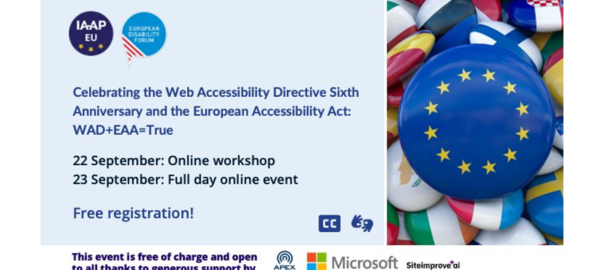
V kalendáři akcí zaměřených na digitální přístupnost a inkluzivní design by vám nemělo uniknout setkání, které na začátek února 2026 připravuje evropská pobočka asociace IAAP ve spolupráci s organizací Vially. Akce s názvem IAAP EU and Vially Accessibility Hybrid Event se uskuteční v irském Dublinu. A jak už je u těchto akcí zvykem, nabídne i možnost virtuální účasti.

Hlavním tématem zůstává praktická implementace Evropského zákona o přístupnosti (EAA). Tentokrát se však program zaměří na oblasti, které v odborných diskusích občas zůstávají v pozadí – konkrétně na samoobslužné terminály, informační a podpůrné služby či podporu pro koncové uživatele.

Co bude na programu?

Akce je koncipována jako hybridní a je rozdělena do dvou dnů:

Středa 4. února (pouze prezenčně): První den je určen členům IAAP a pozvaným hostům. Proběhne v prostorách The Wayfinding Centre, což je unikátní pracoviště simulující reálné dopravní situace. Na programu je workshop věnovaný požadavkům normy EN 301 549, které jdou nad rámec metodiky WCAG, a prohlídka centra zaměřená na inkluzivní řešení v dopravě.

Čtvrtek 5. února (hybridně): Druhý den je otevřen široké odborné veřejnosti. Program nabídne panelové diskuse o regulatorních aspektech EAA, praktické ukázky přístupnosti mobilních aplikací a pohled velkých technologických hráčů na nové funkce využívající umělou inteligenci.

Proč se zúčastnit?

Pro české odborníky na přístupnost je tato akce zajímavá především možností sdílet zkušenosti s experty a regulátory z ostatních členských států EU. V kontextu již účinného Evropského zákona o přístupnosti jde o dobrou příležitost, jak získat vhled do interpretace požadavků, které se netýkají jen webu, ale i fyzických zařízení a navazujících služeb.

Příjemným faktem je, že virtuální účast na druhém konferenčním dni je pro všechny zájemce zdarma. Organizátoři samozřejmě pamatují i na přístupnost samotného přenosu, který bude doplněn o přepis mluveného slova do textu a tlumočení do mezinárodního znakového jazyka.

Podrobné informace o programu a registrace

Staňte se členkou či členem IAAP

Pokud to s přístupností myslíte vážně, zvažte i individuální členství v IAAP. Kromě přístupu k rozsáhlému archivu webinářů a odborných materiálů, které vám pomohou držet krok s rychle se vyvíjející legislativou i technologiemi, je členství v asociaci přirozeným prvním krokem na cestě k získání mezinárodně uznávaných certifikací jako CPACC či WAS.

Pro zájemce z České republiky je navíc dobrou zprávou, že díky zařazení ČR do kategorie zemí s nižší hladinou členských příspěvků je profesní rozvoj v rámci této globální komunity finančně výrazně dostupnější. Investice do členství se tak v kontextu budování odborného kreditu a přístupu k celosvětovému know-how vrací velmi rychle.

Více o členství v IAAP

IAAP EU Accessibility Event 2025: Masarykova univerzita přivítá přední evropské odborníky na digitální přístupnost

Ve dnech 23. a 24. dubna 2025 se Brno stane centrem evropské debaty o digitální přístupnosti. IAAP EU Accessibility Event 2025 nabídne praktické příklady a zkušenosti, jak řešit přístupnost v praxi, a příležitost osobně potkat přední odborníky z komerčního i veřejného sektoru, zástupce koncových uživatelů, „stakeholdery“ z různých odvětví, na něž se vztahuje Evropský zákon o přístupnosti, výzkumné pracovníky, zástupce orgánů dozoru a tvůrce politik.

Akce se koná v prostorách Masarykovy univerzity na Komenského náměstí 2 v Brně. Jejím hostitelem je univerzitní Středisko Teiresiás, pořadatelem IAAP EU, akci podpořily společnosti Amazon, Deque a Microsoft.

Co vás čeká?

Středa 23. dubna

Středa 23. dubna je vyhrazena pro workshop primárně určený členům IAAP. Během tohoto workshopu, který povedou odborníci z různých zemí EU, budou členové IAAP, zástupci dozorových a monitorovacích orgánů i uživatelé se zdravotním postižením společně pracovat na výkladu, testování a slaďování požadavků normy EN 301 549 nad rámec doporučení WCAG. Výstupy z workshopu přímo přispějí k probíhající revizi normy EN 301 549 a budou volně dostupné.

Čtvrtek 24. dubna

Čtvrteční program je určen i pro širokou veřejnost. Všichni zájemci o tematiku digitální přístupnosti se mohou těšit na den plný konkrétních příkladů, zkušeností a inspirace. Prezentace a panelové diskuse pokryjí následující témata:

  • Zavádění Evropského zákona o přístupnosti do praxe
  • Bankovní služby – technické aspekty
  • E-shopy – přístupnost z pohledu uživatelského rozhraní
  • Počítače, chytré telefony a operační systémy – obsah a srozumitelnost
  • Elektronické knihy – na co se vztahují požadavky
  • Televize a audiovizuální média – možnosti přizpůsobení a asistivní technologie

Prostor samozřejmě bude i pro otázky z publika.

V průběhu akce také bude volně přístupná menší výstava, na které se budete moci seznámit s přístupnými produkty a službami některých partnerů akce.

Jak se akce zúčastnit?

Akce je koncipována jako jeden z benefitů pro členy IAAP – Mezinárodní asociace specialistů na přístupnost.

Nejsnazší cesta, jak si na akci zajistit účast bez toho, aniž byste museli platit účastnický poplatek, je stát se členem IAAP – vstup na akci tak budete mít zdarma jako součást benefitů pro členy.

S vedením IAAP se mi podařilo vyjednat zařazení Česka mezi Emerging and Developing Economies (E&DE), aby členský poplatek odpovídal kupní síle a obvyklým cenám v regionu.

Zájemci z České republiky tak nově mohou mít členství v IAAP za 65 (místo 235) dolarů za rok.

Jakmile se stanete členem, můžete se standardním způsobem na akci zaregistrovat

Vážným zájemcům o prezenční účast, pro které by byla výše účastnického poplatku překážkou v účasti, nabízím několik volných vstupenek. V případě zájmu mi napište na pavlicek@teiresias.muni.cz.

Těšíme na setkání 🙂

Další informace